What commercial zoning is, how zoning codes label districts, what zoning controls, how variances and rezoning work, and zoning in Colorado mountain towns.
Zoning is the local law that sets which activities are allowed on a lot, such as residential, commercial, industrial or agricultural use, and at what density. Commercial zoning is the category for business uses such as shops and offices.
Zoning codes differ by town, though many label commercial districts with a C. Zoning is an early checkpoint in the development process.
For a buyer, zoning answers one question before any other: can this property be used the way you plan? This guide explains how codes work, how to check a lot and what to do when the zoning does not fit.
Where Zoning Comes From
Zoning is a power of local government, granted by state law and upheld by the U.S. Supreme Court.
The key case is Village of Euclid v. Ambler Realty Co., decided in 1926 by a 6-3 vote. The Court held that a village ordinance dividing land by use, height and area was a valid exercise of police power. Use-based zoning is still called Euclidean zoning after that village in Ohio.
In Colorado, two statutes give the power to zone:
- Cities and towns: C.R.S. 31-23-301 lets a municipality regulate building height, stories, size, lot coverage, yards and density. It also covers where land is used for trade, industry or homes.
- Counties: C.R.S. 30-28-111 lets a county planning commission make a zoning plan covering similar items, including the use of land for trade, industry and recreation.
So a property inside town limits follows the town’s code, and a property in unincorporated land follows the county’s code. Check which one applies before reading any rules.
How Zoning Codes Label Districts
There is no single zoning system, but codes often use R for residential, C for commercial and I for industrial. Most U.S. codes are use-based, an approach known as Euclidean zoning.
Each label stands for a district with its own list of allowed uses and building rules. Numbers or suffixes usually show intensity, so a C-2 district typically allows more than a C-1 district in the same code.
Common commercial district types
| District type | Typical uses | Where you find it |
|---|---|---|
| Neighborhood commercial | Small shops, cafes, personal services | Near homes, small lots |
| General commercial | Retail, restaurants, offices, auto services | Arterial roads and highways |
| Mixed use | Shops below offices or apartments | Downtowns and main streets |
| Office or business park | Offices, clinics, light assembly | Campuses near highways |
| Light industrial | Warehouses, contractor yards, flex space | Edges of town, near rail or highways |
| Heavy industrial | Manufacturing, outdoor storage | Separated from homes |
The names change from code to code, so always read the district’s own purpose statement and use table.
Two Colorado examples
Denver’s code builds each name from parts. The first part is the neighborhood context and the second is the general use or form. The third is a lot-size letter or a height number.
In Denver, C stands for Urban Center, MS for Main Street, MX for Mixed Use and CC for Commercial Corridor. A C-MX district is therefore a mixed-use district in the Urban Center context, with the number setting the maximum building height.
Grand Junction uses simpler names. Its use table lists mixed-use districts MU-1, MU-2 and MU-3, a Commercial General (CG) district, and industrial districts I-OR, I-1 and I-2.
What Zoning Controls
Zoning controls the use, the density and the shape of what you build.
- The kinds of activity allowed on a lot
- The density of that activity
- Subdivision, setbacks and parking requirements
Use: by right, conditional or prohibited
Most codes sort uses into three groups in a use table.
| Category | What it means | What you need |
|---|---|---|
| Use by right | Allowed outright in the district | A building permit and code compliance |
| Conditional or special use | Allowed only if approved for this site | A public review, often with conditions |
| Prohibited | Not allowed in the district | A rezoning, or a different property |
A conditional use can add months to a project and can be denied. Price a property on what is allowed by right, unless you are prepared for a review.
Codes can also limit how big a use can be. Grand Junction, for example, caps artisan industrial uses in its mixed-use districts at 10,000 square feet of floor area.
Building shape and site rules
Zoning also sets the size and placement of buildings. Common standards include:
- Height: maximum feet or stories.
- Lot coverage: the share of the lot buildings may cover.
- Setbacks: the distance a building must sit from each property line.
- Floor area ratio: total floor area divided by lot area.
- Parking: spaces required per unit, per seat or per square foot.
- Landscaping, signs and lighting: design rules for the site.
Overlay districts
An overlay adds rules on top of the base district. Denver, for example, uses design overlays, use overlays and conservation overlays.
Overlays are common for historic downtowns, airports, floodplains and wildfire areas. A lot can meet the base district’s rules and still fail an overlay requirement.
How to Check the Zoning on a Property
Checking zoning takes a few steps, and it belongs in every purchase contract’s due diligence period.
- Confirm the jurisdiction. Find out whether the lot is inside a city or town, or in the unincorporated county.
- Look up the district. Most Colorado cities and counties publish an online zoning map, often in a GIS viewer.
- Read the use table. Confirm your exact use is allowed by right, needs review or is prohibited.
- Check overlays and plans. Look for overlays, a planned unit development or site-specific conditions.
- Ask the planning department. Many planning departments will confirm a lot’s zoning in writing.
- Confirm current use is legal. Check that the existing building and use had permits, or are a legal nonconforming use.
Zoning is one item on the full pre-purchase checklist. Recorded easements and covenants can also limit a site; see how easements affect a property.
Variances, Rezoning and Nonconforming Uses
If zoning does not fit your plans, you can ask for an exception or a change, or rely on an existing use.
- Variance: an exception granted because of a hardship particular to the property.
- Rezoning: a change to the district, which can be challenged as spot zoning if it favors one owner.
- Nonconforming use: an existing use allowed to continue after the rules change.
Variances in Colorado
Variances are decided by a board of adjustment. Under C.R.S. 31-23-307, a municipal board may vary the rules where practical difficulties or unnecessary hardships stand in the way of strict compliance.
Unless a local ordinance says otherwise, four members of the board must agree to grant a variance. A town council can also remove the board’s power to grant use variances, leaving only dimensional relief.
Jefferson County’s process shows what to expect:
| Step | What happens |
|---|---|
| Intake | Staff check the application, and the fee is paid |
| Review | A case manager reviews the request and visits the site |
| Notice | Neighbors get notice, and the applicant posts a sign for 14 days |
| Hearing | The board hears the case; four of five members must approve |
| Timing | About two months from submission |
The county reserves variances for cases where meeting a standard is impossible or exceptionally difficult. Economic hardship alone does not qualify, and a variance approves a specific structure rather than changing the zoning.
Rezoning and planned unit developments
A rezoning changes the district on the map. It usually needs a planning commission recommendation and a vote by the town council or county commissioners, with public hearings.
Larger projects often use a planned unit development (PUD). Colorado’s Planned Unit Development Act of 1972 lets local governments approve custom rules for a site. Its stated aims include commercial facilities near housing and more variety in building type and layout.
Nonconforming uses
A nonconforming use was legal when it started but no longer fits the current code. It can usually continue, but codes often limit expansion and end the right if the use stops for a set period.
If you buy a nonconforming property, confirm its status in writing and ask how long it can sit vacant before the right is lost. Lenders and insurers will ask the same question.
Mistakes to avoid
- Assuming a “commercial” label allows your exact use.
- Relying on the seller’s or listing description instead of the code.
- Ignoring parking rules, which can limit a restaurant or medical office.
- Closing before a needed conditional use or rezoning is approved.
- Forgetting county rules when a property sits just outside town limits.
Zoning in Colorado Mountain Towns
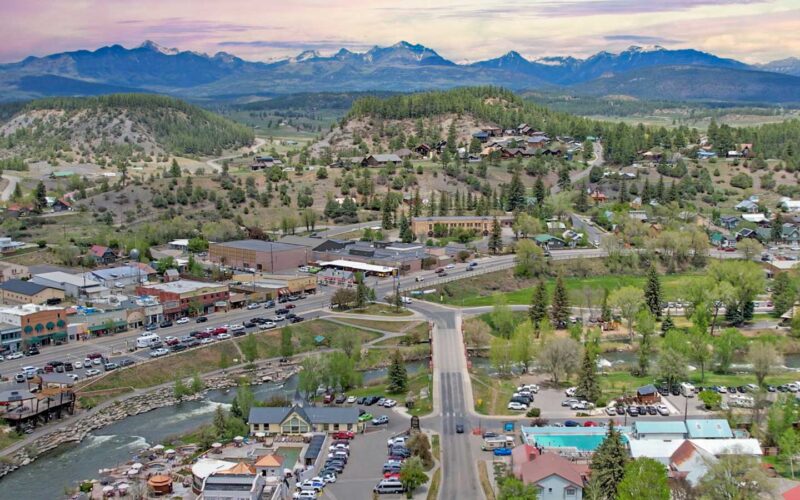
In Colorado mountain towns, limited zoned land shapes what can be built. Topography and zoning restrictions prevent much new industrial development around Durango. In nearby Mancos, one building is the only light-industrial-zoned building in the market. See checking zoning before buying land.
RMCRE’s Durango 2026 outlook adds that new industrial building works for owner-users. Building on speculation is hard because of land costs and zoning limits.
RMCRE’s 2025 and 2026 market updates show how zoning and approvals shape each town:
| Town | Report | Zoning or land-use item |
|---|---|---|
| Steamboat Springs | Q2 2026 | Final plat approved for a 29-lot industrial park at the airport; 17 lots under contract |
| Grand Junction | Q2 YTD 2026 | Site work began on The Terminal, a 100,000-square-foot, 72-unit mixed-income, mixed-use project |
| Montrose | Q4 2025 | A new Amazon distribution center of about 20,000 square feet was completed |
| Colorado Springs | Q2 2026 | A Wildland Urban Interface ordinance revised fire-resistance rules for building in wildfire-prone areas |
What this means for buyers
Industrial and mixed-use land is scarce in the mountains, so properties already zoned for those uses often sell at a premium. A lot that needs a rezoning carries more risk and should be priced that way.
Wildfire, floodplain and steep-slope rules also matter. In many mountain areas, these overlays decide the building footprint more than the base district does.
Many mountain-town main streets mix shops with offices or apartments above. See mixed-use zoning on mountain main streets and the Steamboat Springs Q2 2026 report.
Frequently Asked Questions
What does C-1 or C-2 zoning mean?
They are common names for commercial districts, but each town defines them differently. In many codes, a higher number allows more intense uses. Always read that town’s use table to confirm.
Does zoning affect property value?
Yes. Zoning sets what a lot can legally hold, so it limits the income and the buyers a property can attract. A lot zoned for a scarce use, such as light industrial in a mountain town, can sell for more than a lot that needs rezoning.
Can you appeal a zoning decision?
Usually, yes. A board of adjustment hears appeals of decisions by zoning staff, and decisions of elected boards can be challenged in court within short deadlines. Ask a land use attorney about the deadline that applies.
Can you live in a commercially zoned building?
Sometimes. Many mixed-use and some commercial districts allow apartments above shops, while others prohibit housing. The local use table decides.
How long does a rezoning take in Colorado?
It varies by town and county. A rezoning needs public hearings before the planning commission and the elected board, so it usually takes months. Ask the local planning department for its current schedule.
Who decides zoning in unincorporated Colorado?
The county does. Under C.R.S. 30-28-111, the county planning commission prepares the zoning plan, and the board of county commissioners adopts it.
Entitlement Help in Colorado
RMCRE members support approvals from pre-application to decision, working with local planners they know. See RMCRE entitlement support.