What to Know About Industrial and Warehouse Property in Grand Junction
Industrial property is the backbone of Grand Junction’s commercial market. As the distribution and service hub for all of western Colorado and eastern Utah, the city supports steady demand for warehouse, flex, and light manufacturing space that has held up better than almost any other category. For business owners who need space and investors looking for reliable tenants, this is often the most straightforward and dependable part of the local market. Here is what you should know before you buy.
Why Is Industrial So Strong in Grand Junction?
Industrial is strong here because of geography and logistics. Grand Junction is the largest city between Denver and Salt Lake City, which makes it the natural distribution point for a vast, thinly populated region.
Businesses serving western Colorado and eastern Utah need somewhere central to warehouse inventory, run service operations, and dispatch from. Grand Junction sits at the intersection of Interstate 70 and U.S. Highway 6 and 50, with a regional airport and rail access, which is exactly the infrastructure that industrial users require. That role is not going anywhere, which gives the sector a durability that is harder to find in retail or office.
Where Is the Industrial Inventory Located?
Grand Junction’s industrial inventory concentrates in two main corridors, the area around Grand Junction Regional Airport and the stretch along U.S. Highway 6 and 50. Both grew up around transportation access, which remains the primary driver of location decisions for industrial users.
The Airport Corridor
The area near Grand Junction Regional Airport supports users who value air freight access and proximity to the Horizon Drive commercial corridor. It has drawn a mix of distribution, service, and light industrial operations.
The Highway 6 and 50 Corridor
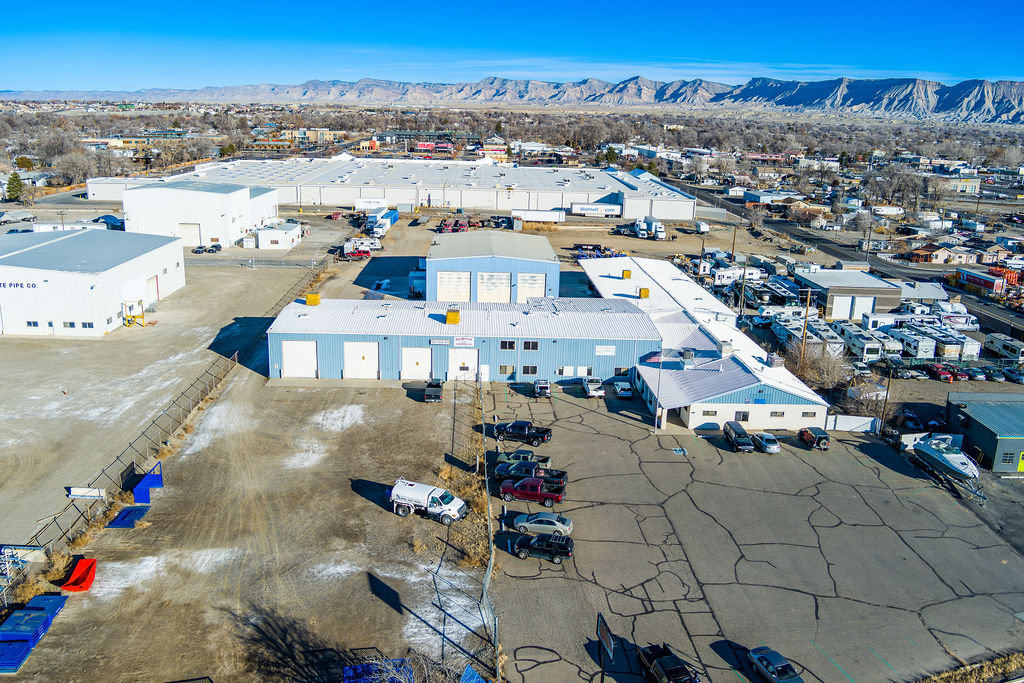
This corridor is the workhorse of the local industrial market, with strong highway access for trucking and distribution. It holds a significant share of the area’s warehouse and flex inventory.
Clifton
Just east of the city, Clifton carries a large concentration of the region’s industrial and flex listings. It tends to offer more affordable pricing than in-town locations while keeping good highway connectivity.
Las Colonias Business Park
Las Colonias represents the newer end of the market, a mixed-use business park that has become a focus for light industrial and modern commercial development.
What Does Vacancy and Pricing Look Like?
Industrial vacancy in Grand Junction has held in the range of roughly 5 to 10 percent, which is tight enough to support pricing and rent growth without being so constrained that nothing is available. The market has shown steady absorption and gradual rent inflation rather than dramatic swings.
The regional inventory totals somewhere around 8 million square feet, and it is important to understand its character. This is predominantly local service space serving regional users, not large institutional-grade distribution centers built for national tenants. Buildings tend to be smaller, more functional, and priced accordingly.
For context on the broader market, cap rates in Mesa County averaged 7.0 percent in the first quarter of 2026, and commercial sales volume was up 5 percent year over year. Our Mesa County Q1 2026 market update covers the full quarterly numbers.
Should Your Business Buy or Keep Leasing?
Buying makes sense when your space needs are stable and you plan to stay in the market long term, since ownership builds equity and gives you control over a facility you depend on. Leasing makes more sense when you are growing unpredictably or unsure about your footprint.
For many Grand Junction businesses, the case for buying is stronger than it might be elsewhere. Entry pricing is lower than Front Range markets, industrial inventory is functional and reasonably priced, and owning removes the risk of a landlord repositioning or selling the building your operation runs out of. If your business is established locally and your space requirements are predictable, ownership is worth running the numbers on seriously.
What Should Buyers Watch Out For?
Industrial buyers should pay close attention to the physical specifics of a building, because industrial suitability is far more technical than other property types. The details that matter include clear height, loading configuration and dock access, power capacity, floor load, yard space and truck turning radius, and zoning that actually permits your intended use.
There are also two local factors worth building into your planning. Grand Junction adopted the 2025 Colorado Wildfire Resiliency Code in March 2026, which introduces new building requirements for development in wildfire-prone areas and can affect construction and renovation budgets. And because much of the local inventory is older, environmental due diligence deserves genuine attention, particularly on properties with a history of industrial or automotive use.
None of this should discourage you. It simply means industrial acquisitions reward careful diligence and knowledgeable representation.
Why Work With a Local Broker on Industrial Property?
A local broker matters on industrial deals because building suitability and corridor knowledge are highly specific, and a lot of Grand Junction industrial activity moves off-market before it is ever advertised. Knowing which buildings have the right specs, which corridors suit your operation, and which owners might be open to selling is knowledge that only comes from working the market daily.
In Grand Junction, Rocky Mountain Commercial Real Estate is represented by Bray Commercial Real Estate, a fourth-generation Western Colorado firm founded in 1946. That depth of local history is what surfaces the right building rather than just the available one.
The Bottom Line
Industrial and warehouse property is the strongest and most dependable segment of the Grand Junction commercial market, supported by the city’s permanent role as a regional distribution hub. Whether you are buying for your own operation or as an investment, the fundamentals here are solid. Explore commercial real estate in Grand Junction, browse the current commercial real estate for sale in Grand Junction, or contact our team to find the right industrial property for your needs.